AI and the carve-out of middle class power
This post is a reformulation of many of the ideas expressed in David Graeber's fantastic book Bullshit Jobs.
1. Corporations exist as a mechanism to extract value from their clients and their suppliers.
We can think of a corporation as kind of entity whose sole purpose to is extract value from both its customers and its suppliers. How effectively it is able to do this depends on on market conditions - for example, a more competitive market may neccesitate lowering prices rather than extracting the surplus to shareholders.
At the top of this extraction mechanism, the CEO's incentives are usually pretty aligned with the shareholders' - the CEO usually has a bonus structure that is tied to measures like profit or share price.
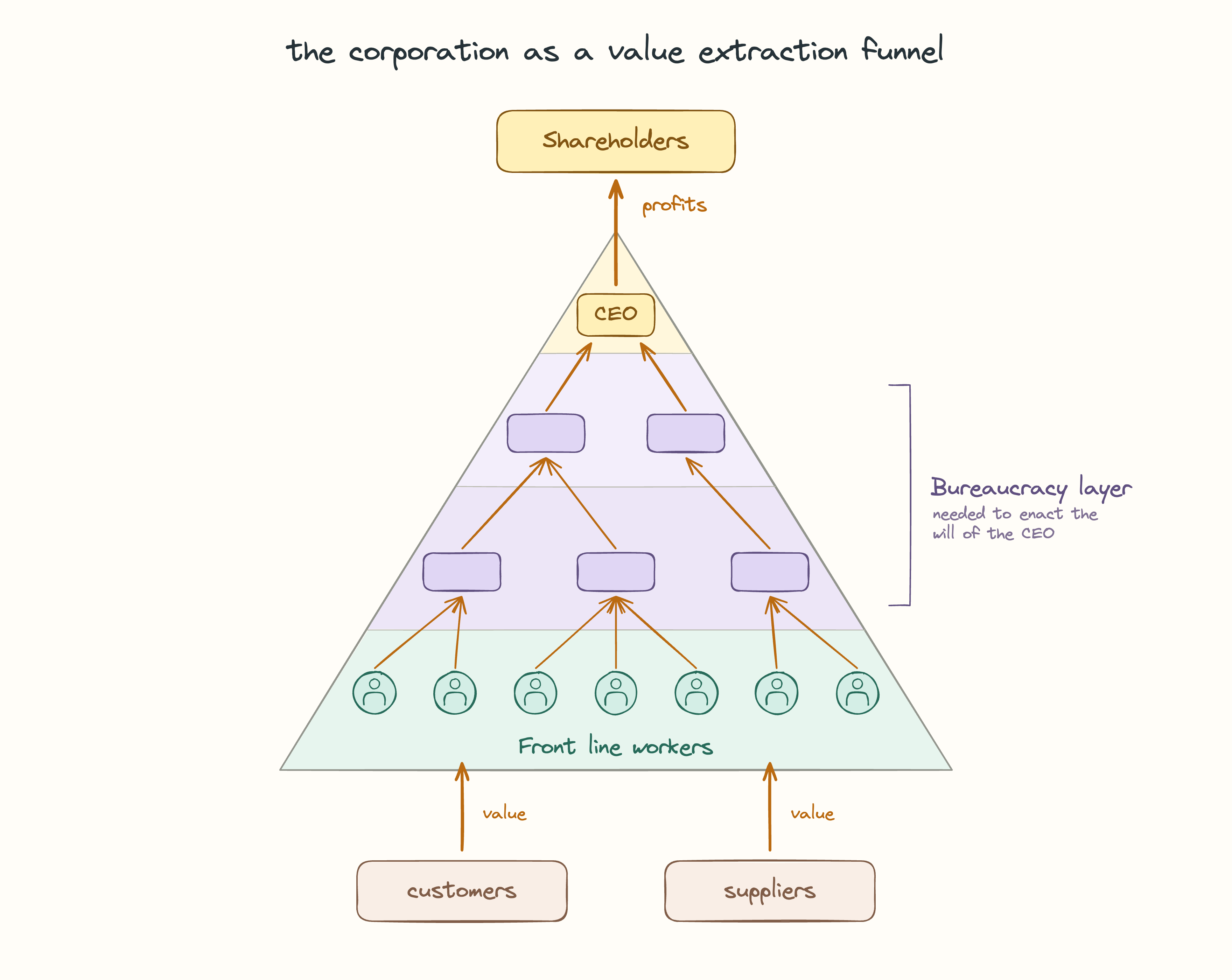
2. A parasitic bureaucracy exists
I use the term 'parasitic' purely as an objective descriptor - not as a disparagement. I myself am a member of this bureaucracy!
The CEO cannot simply order those who are actually producing or selling the goods to work in a certain way. Instead they parcel this work out to some executives, who parcel the work out to some senior managers, who... and so on.
The people at these middle layers do not have the same value extraction incentive that the CEO does.
A company can try to align individual incentives with the company's overall purpose, for example by giving bonuses based on company performance, but the individual bureaucrat's individual impact on this goal, and the corresponding reward is small - so it is likely that the individual other goals will be given higher weight. For example, getting the experience with a particular technology they need to move into a higher paying job, seeing the world on the company card, promoting their public profile, or simply, demanding a higher salary.
This parasitic bureaucracy is not all malign - the individuals in this layer are still useful enough to the company to justify their existence, lest they be excised completely, but the inefficiencies of any corporation can be explained with this model - the more directly an individual is involved with the value extraction funnel, the more leverage they have to siphon off the value, be it by demanding a higher salary or just taking their time to do their task.
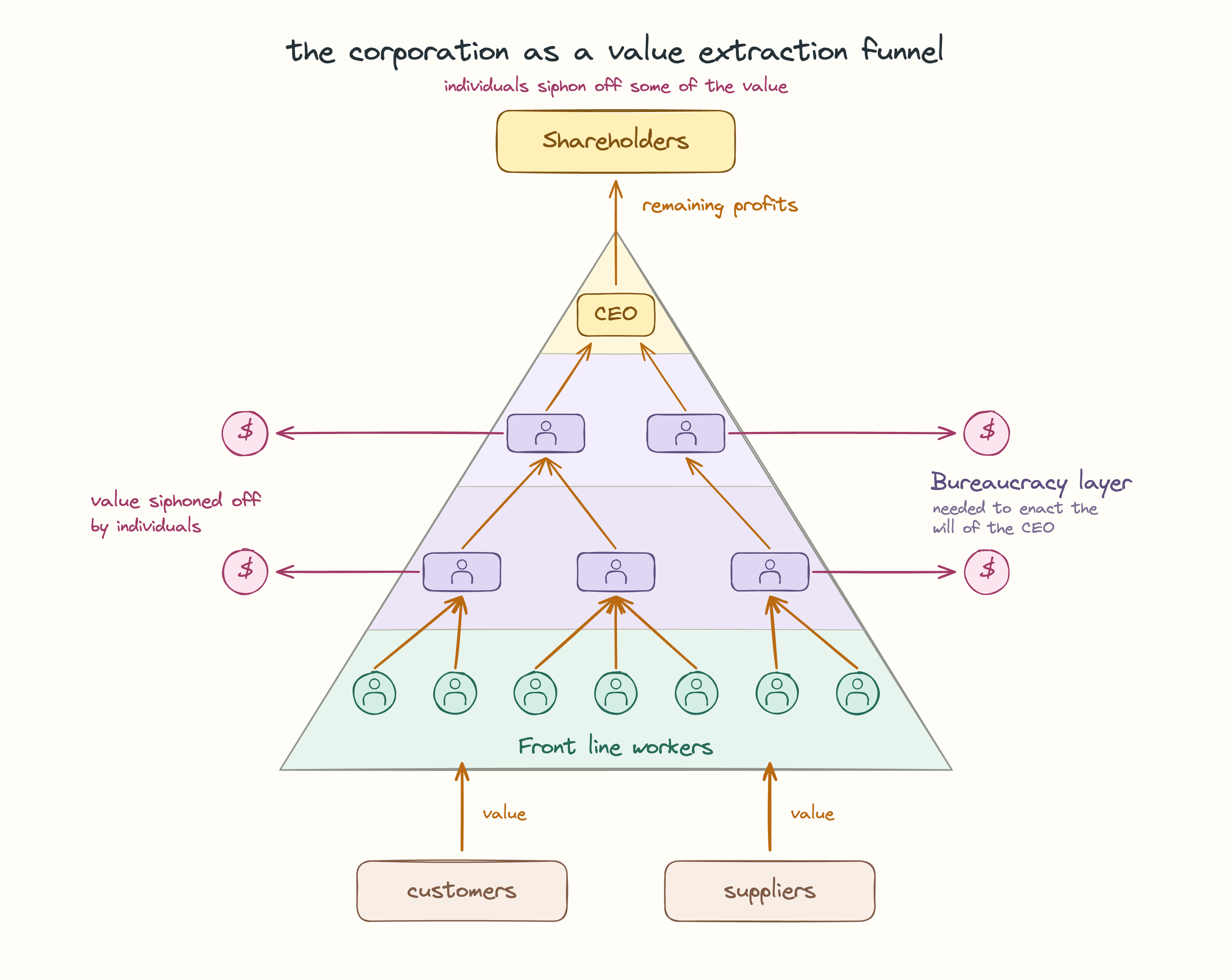
Relating this to software engineering - my impression is that in the past software engineers have held relatively a lot of power within an organisation - their work not being easily understood or replaceable, and as such have been able to demand high salaries and comfortable working conditions.
Sidebar: Feudalism
In the conclusion of his book, Graeber coins the term 'managerial feudalism', it might be worth dwelling on some of the dynamics of feudalism.
In a feudal system, all of the land technically belongs to the king. But the king, with his retinue of knights, does not have the power himself to enforce his will, so he parcels the land out to several dukes. The dukes have their own retinue of knights, but they too, can't control all that land themselves, so they in turn parcel it out to some lower lords, and so on.
Now importantly, the king doesn't want his dukes getting on too well with each other, if they did, they might all get together and depose him.
And so, while the king might genuinely want to be an effective administrator of the kingdom, might genuinely want to improve the roads etc, his more important job is managing the power politics of the kingdom, making sure the dukes don't become unified. This might involve encouraging a small war between dukes - not good for the kingdom - but good for maintaining power.
How to tie this back to bureaucracy? I'm not sure, but the point is that individual incentives being as they are, there can be scenarios where the rational thing is to actively make things worse, to improve one's own position.
For example, imagine a warehouse manager who manages a staff of fifty people who all need to do regular stocktakes to make sure everything is correct. A bright engineer tells the warehouse manager that they could create a system that uses barcodes all do all this inventory management automatically. This would be in the interests of the company, but the manager would now be a manager of say four people, and the company might decide that they don't need the manager at all. The manager has an incentive to preserve the old inefficient system because the company needs them to manage it.
3.The parasitic bueacracy can be replaced with AI
I want to reemphasise, when I use the term 'parasitic bureaucracy' I do not do it to malign the members of it - an alternative framing is that this is middle class power. The controlling interests have to grant concessions to the middle classes - because they need them.
If this parasitic bureaucracy can be replaced by AI - what happens? The CEO no longer needs to pass their orders through this human bureaucracy, they can give them to the AI directly.
The AI does not have the same orthogonal incentives, (except in the cases where it does - see the alignment problem), and so replacing this bureaucracy with AI means... pure value extraction.
It's likely not that simple - how much of this previously-siphoned value can now land in the shareholders' pockets depends on market conditions - it could be that the company cuts prices to retain competitiveness, it depends on how competitive the market is.
4. So what happens to the middle class?
If we accept this framing that the middle class has power because the people at the top need them, when AI means that the middle classes aren't needed, what happens?
1. New jobs are created
To give a parallel with the industrial revolution - the industrial revolution may have disrupted cottage industries like textiles, but the machines now required new machines to build tools to service textile machines, needed people with the smarts enough to service the machines.
AI will greatly increase the surface area of software - as software engineers our jobs are changing, but I personally am not worried as a software engineer - there is going to need to be people to sort out these whole new jungles of AI generated code.
2. The middle class votes their power back
In this world, the middle class lose their jobs, and vote for parties that restore their power - a wealth tax, universal basic income, a tax on AI.
The power try to prevent this by influencing public sentiment via social media.
3. A dystopian world where the wealthy are not beholden to a middle class to enact their will
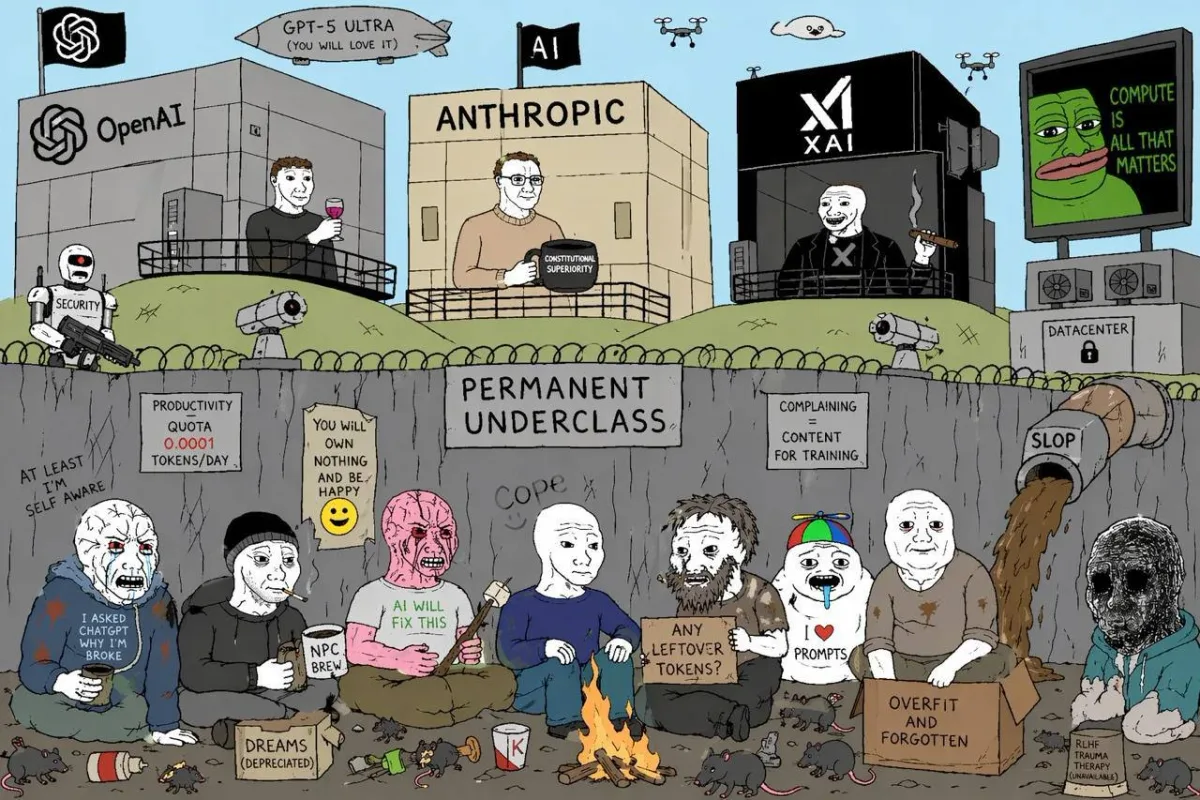
There may still be jobs, but these are easily replaceable manual labour type jobs, not the kind that leads to the siphoning that occurs in a bureaucracy.
The powerful are protected by loyal autonomous weapons, no police force or military switch sides and join a revolution.
Questions? Comments? Criticisms? Get in the comments! 👇
Spotted an error? Edit this page with Github