An inversion of information discovery
Once upon a time, the way I discovered technical information was like this:
- I do a Google search, and then I pick a result from Stack Overflow or tutorial blog, or I navigate straight to that framework's documentation, and look at the 'getting started' or 'concepts' documentation section.
- This gives me a high level overview of the concepts, usually with links to further details.
- If I need further details then I dig into the API documentation.
- From there, if I need more details I'm:
- I'm doing searches in the GitHub issues or pull requests
- Creating code reproductions to test that behaviour that I'm looking for
- As a failure mode, I'm looking into the framework source code to understand the thing.
That is, the model of information discovery is that we look high level first, and dig into the more details as we need it.
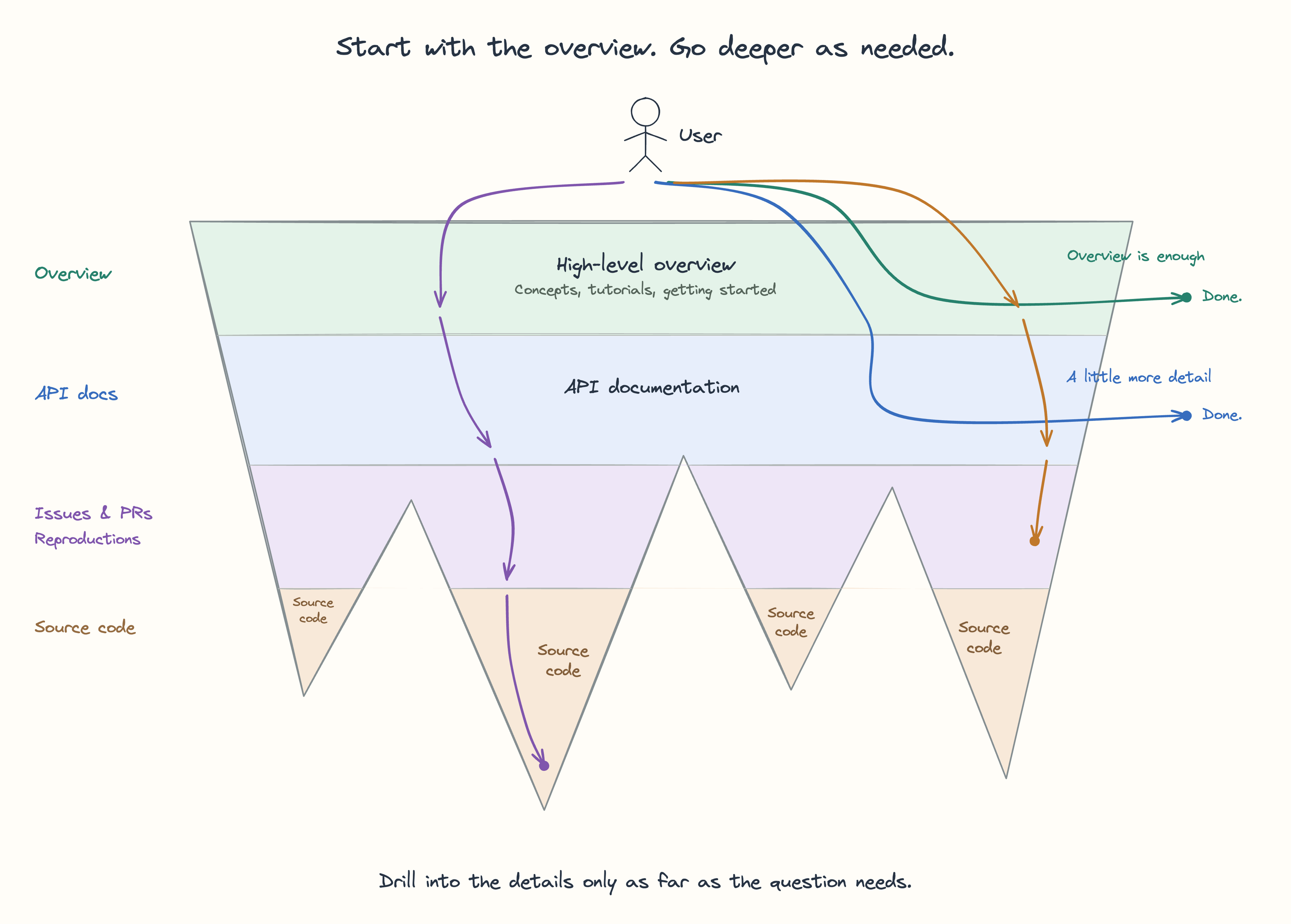
We can add a step 0 to this process:
- I passively browse social media and see certain concepts, tools or techniques be talked about, and that might be enough for me to search those later.
With AI, this might have changed,
Part of this is not specific to AI - Google search has been in decline for a while now - but I'm finding that 'search first' is no longer reliable.
- That surface level content is often AI generated now, and as a heuristic, I don't know if it's worth reading further into it, without knowing if there's actually anything concrete behind it.
- AI is good at answering surface level questions directly.
Instead, with AI, we can have the AI take the opposite approach:
- Start deep - start with reading source code, reading academic papers, reading technical specifications.
- Have the AI develop a coherent conceptual picture
- Finally have the AI formulate the high level overview.
Then, you can drill into the details as much or as little as needed.
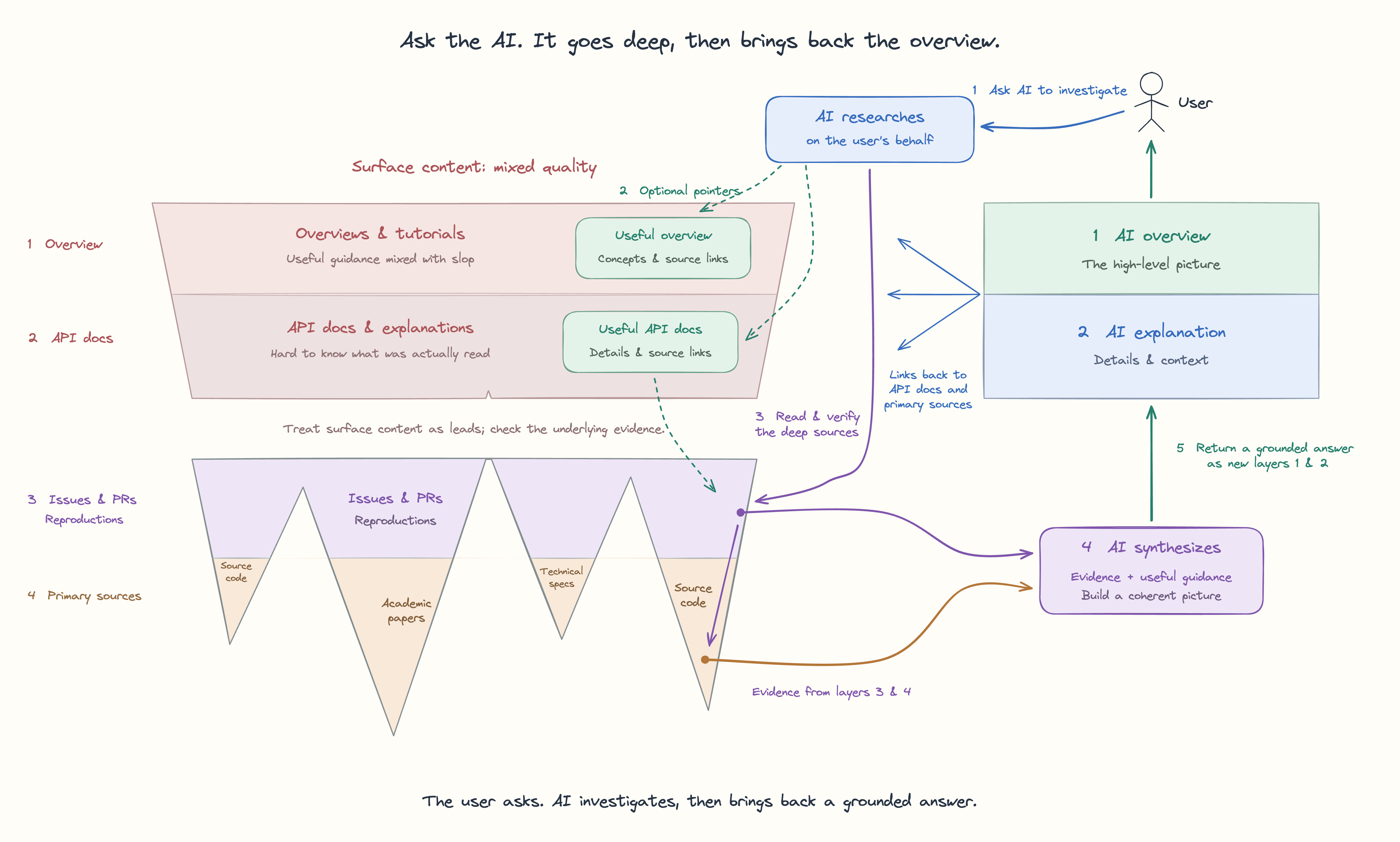
Of course, there's always the possibility that there's going to be a hallucination between what the AI reports to you and what it read.
To this, I say:
- Not to say that it won't happen, but I trust the models for the most part these days.
- More to the point, what's the alternative? We live in an AI slop world whether we like it or not.
Practical conclusions
As a reader
- Create skills with a workflow designed for 'deep knowledge first'.
- Such skills will likely require the higher model effort setting - and will as such be slow. So there's still something to be said for 'just tell me what you already know'.
User: Tell me about XYZ. Agent: Ah, XYZ, XYZ is a flippty floop, zip zap. User: /deep-research I'm specifically trying to solve X. Find what you can about solving this particular problem for flippty fap and zip zap.
As a documentation writer
I haven't tested this hypothesis - chances are AI is still encountering your content via surface level, documentation sites, GitHub root README.md - in these, add pointers to things like tests that demonstrate the tool's specific capabilities.
Questions? Comments? Criticisms? Get in the comments! 👇
Spotted an error? Edit this page with Github